What is SCARwork? Understanding Scar Tissue + Why It Matters

What is SCARwork?


Scar tissue tells a story—but sometimes, it’s one the body is still trying to process.

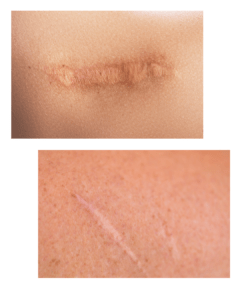
SCARwork is a gentle, hands-on therapy focused on improving the mobility, texture, and integration of scar tissue within the body. Whether from surgery, injury, or burns, scars don’t just exist on the surface—they affect multiple layers of tissue, including the fascia, which plays a major role in how your body moves and feels.

While many people think of scars as purely cosmetic, they can create deeper restrictions that impact posture, movement, and even pain patterns throughout the body.


Why Scar Tissue Matters More Than You Think

Scar tissue forms as part of the body’s natural healing process. However, it doesn’t always organize in the same flexible, functional way as healthy tissue.

This can lead to:

  • Tightness or pulling sensations
  • Limited range of motion
  • Compensation patterns in other areas of the body
  • Chronic discomfort or pain
  • A feeling of “disconnect” in the affected area

Because fascia is a continuous system throughout the body, a restriction in one area can influence movement somewhere completely different.


A Different Way to Think About Healing

Many traditional approaches focus on the appearance of the scar or attempt to “break up” tissue aggressively.

SCARwork takes a different approach.

“What I wish to achieve in scar tissue is to soften it, to fill it, to have it integrate with the tissue around it.”

Rather than forcing change, the goal is to invite the body back into movement and connection.

This means:

  • Working gently and intentionally
  • Respecting the layers of the tissue
  • Allowing the nervous system to feel safe
  • Supporting long-term, sustainable change

It’s Not Just About the Scar

One of the most important things to understand is that scars don’t exist in isolation.

They can influence:

  • Posture
  • Breathing patterns
  • Muscle activation
  • Overall body alignment

That’s why SCARwork often complements practices like Structural Integration—looking at the body as a whole system, not just a single area.


Who Can Benefit from SCARwork?

SCARwork can be helpful for people with:

  • Surgical scars (C-sections, joint replacements, etc.)
  • Injury-related scars
  • Burn scars
  • Old scars that still feel tight or restricted
  • Newer scars that are fully healed but not functioning well

Even scars that are years—or decades—old can still respond to this work.


Final Thoughts

Healing doesn’t stop once a wound closes.

SCARwork recognizes that beneath the surface, there’s still an opportunity for the body to regain movement, ease, and connection.

In the next post, we’ll dive deeper into how SCARwork actually works and why a gentle, layered approach is key.

What is Ehlers-Danlos Syndrome?

Ehlers-Danlos Syndrome: Symptoms, Support, and How Structural Integration or Rolfing May Help

What is it?

Ehlers-Danlos syndrome, often called EDS, is a group of inherited connective tissue disorders that can affect the joints, skin, blood vessels, and other tissues throughout the body. In general, EDS is associated with joint hypermobility, skin hyperextensibility, and tissue fragility, though symptoms and severity can vary widely depending on the type. There are 13 recognized types of EDS, and hypermobile EDS is one of the most commonly discussed.

Many people with EDS deal with symptoms that can be frustrating, painful, and difficult to explain. Common signs can include overly flexible joints, frequent sprains or subluxations, chronic pain, fatigue, easy bruising, abnormal scarring, soft or stretchy skin, headaches, and digestive or autonomic issues. For some, symptoms are mild. For others, they can significantly affect daily life and function.

Because EDS affects connective tissue, the body often has to work harder to create stability. Muscles may become overworked trying to support lax joints, and that can contribute to chronic tension, discomfort, guarding, and fatigue. Exercise and physical therapy are widely recognized as important parts of management because stronger muscles can help support hypermobile joints and improve function. There is no cure for EDS, but treatment and symptom management can make a meaningful difference.

What are some options?

This is where some people become interested in hands-on therapies such as structural integration or Rolfing. Structural integration is a form of manual therapy that focuses on fascia, posture, movement patterns, and whole-body alignment. Some small studies on structural integration suggest it may help with pain, mobility, posture, or movement quality in certain populations, but the research base is still limited, and high-quality evidence specific to EDS is lacking. A recent evidence review commissioned by the Australian government found no existing systematic reviews specifically evaluating Rolfing or structural integration.

That matters, because when we talk about EDS, it is important to be both hopeful and careful. Structural integration or Rolfing should not be presented as a cure for EDS. However, it may serve as a supportive, individualized tool for some people, especially when the goal is to reduce muscular tension, improve body awareness, encourage more efficient movement patterns, and help the body feel less guarded. This kind of work may be most helpful when it is gentle, adapted for hypermobility, and paired with a broader plan that includes medical care, strengthening, stability work, and symptom-informed pacing. Evidence for hEDS and generalized hypermobility currently more strongly supports therapeutic exercise and motor function training than hands-on bodywork alone.

For individuals with hypermobility, the biggest consideration is finding practitioners who understand that more movement is not always better. Many people with EDS do not need to be pushed deeper into stretch. They often need support, control, proprioception, and less strain on already unstable joints. Some hypermobility guidance notes that gentle manual therapy, soft tissue work, and myofascial techniques can be helpful for pain and muscle spasm, but they should be used thoughtfully and as part of a larger stability-focused plan.

It is also important to remember that EDS is not one-size-fits-all. Some types, especially vascular EDS, carry serious risks related to blood vessel and organ fragility. Vascular EDS can involve arterial, intestinal, or uterine fragility, and potentially life-threatening rupture or perforation. That is one reason it is essential for anyone with known or suspected EDS to check with their physician or specialist before beginning any new hands-on treatment plan.

If you have EDS or suspect you may have it, the best next step is to talk with your doctor and build a care team that understands hypermobility and connective tissue disorders. If you are considering structural integration or Rolfing, look for a practitioner who is willing to work gently, communicate clearly, and coordinate with your broader treatment plan. Supportive bodywork may be a useful part of feeling better in your body, but it should always be approached with care, medical awareness, and realistic expectations.

A gentle reminder: this article is for educational purposes only and is not medical advice. If you have EDS, hypermobility, frequent joint instability, unusual bruising, severe pain, dizziness, fainting, or a known vascular condition, consult your doctor before starting structural integration, Rolfing, or any other manual therapy.


Maintenance for Your Body with Structural Integration


Timing your maintenance:

  • When you feel you are sinking back into yourself

    • Neck  begins to shorten

    • You feel a bit shortened all over

    • You feel gravity is taking over (that heavy feeling)

    • Small aches and pains you cannot alleviate on your own

Then you can continue:

    • To keep advancing your structure

    • To continue on your spiritual journey (some people come for this)

    • every 3 to 5 months unless there is an ongoing issue 

        • In which to continue work for a bit (especially if there is a chronic issue)

        • There is a 3 series or 5 series available

          • To include more tracking

Ultimately:

      • advanced work (If you can you sit in a ‘z’ position for 10 minutes)

Other things to consider:

      • Prior to surgery

      • At some point after surgery

      • After a new injury and before compensation happen

        Scar work:

            • Old

            • New

            • After surgery and the scar is not red and there is enough time for deep healing

            • Burns, road rash, major or minor scarring

            • You would be surprised what scars can hand on to


The Goals of Structural Integration

Structural Integration’s goal is to align and balance the body so it can continue to develop into the body that is operating at its maximum.

From the first moment the client enters the room, that person begins a journey into self discovery.  Not only the client’s mind but the client’s body begins to understand and become aware.

I speak with the client to let them know how this works before and after getting on the table. I wish the brain to understand what is going on.  In the meantime, the client’s body also learns by way of touch and tracking movements…from its intention.

Like the work where “awareness makes the change” and understanding through the body how to initiate movement and then moving; that maximum body emerges.  The clients leave with the ability to help themselves.


Our Own Voices


For many of us, listening to a recording of ourselves speak is a truly cringeworthy experience. This phenomenon is so common that the negative reaction even has a name: voice confrontation. When recorded, our voices don’t sound like we think they should partly because a recording removes the sounds we hear internally through the bones in our head, which produce deeper and lower frequency vibrations.

As such, our recorded voices can sound higher in pitch than we’re used to, which can be surprising and not entirely pleasing to our ears. In general, however, the more we listen to recordings of ourselves speaking, the more accustomed we become to how we sound to other people, and the less it makes our skin crawl.

Structural Integration can help transform your voice into a fuller, richer sound because the diaphragm is open.  This allows  the air to fill the diaphragm producing a deeper more grounded voice.  And hopefully one that is more pleasing to yours and other people’s ears.

Like Making Your Bed in the Morning

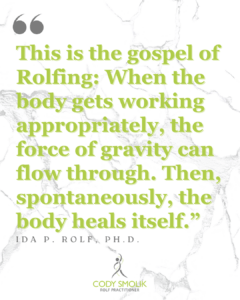
Here is a partial quote from Ida P. Rolf, developer of Structural Integration:

“. . . it can be like making your bed in the morning. You think you’re going to get by without pulling that bed apart, so you pull up this cover and the next cover. When you get all the covers puffed up, you’ve got nine ridges running across the bed. Now you’ve got to go to a deeper layer and organize the deeper layer, and make your bed on top of that. Then you’ve got a made bed. Well it’s the same with the body: you’ve got to organize those deeper layers. . .”


The Working Structure. The Functioning Structure.

Let your structure work for you

In Ida Rolf speak it means  “align’, “unravel”, “lengthen”,  “balance”.  This brings health and ease into the structure.  We also want to re-align, reorganize and unwind the pieces of the body and integrate them so  there is a whole balanced structure.

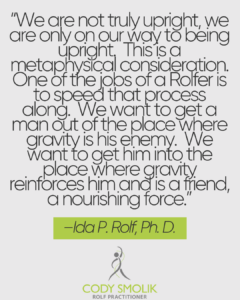
working structureStructural Integration is one of the foremost ways to do this.  The concepts are balancing the structure to work within the gravitational field.   We want a working structure.  We also want it to be able to function in and with gravity; not have gravity work against it.

I want my clients to feel the space inside, the flexibility and ease of movement.  This healing takes on a life of its own.  The body comes alive.


Airplane Mode?

What Is Airplane Mode?

Airplane mode was introduced because of potential concerns that cell phones could cause interference with aircraft instruments during flight. The basic function of airplane mode or flight mode is to block cell tower reception so the phone cannot send or receive wireless communications — while still allowing users to access the rest of a smartphone’s features, like Wi-Fi, music, podcasts, and games. Because many of the same signals that are used for communication by pilots are the same used to connect phones to cell towers, there could be interference if an entire flight full of smartphones were trying to connect at the same time as the plane’s computer system.

Potential Risks of In-Flight Cell Phone Use

In 1991, the Federal Communications Commission (FCC) banned the use of most cell phones and wireless devices during flight. Air traffic control needs to have a constant, direct line of communication with pilots, and there were concerns that cell phone signals could interfere with the ground networks used for communication. While it’s not currently thought that they cause serious harm, there’s a risk that they could create delays and cause confusion for pilots.  The most crucial time for pilots to have this connection to air control is during takeoff and landing, when signals and communications are coming in rapidly and time is of the essence. Even the potential for a cell phone signal to interrupt a pilot during this window is what initially led to regulators requiring that their customers switch to airplane mode.

What Happens if You Don’t Turn on Airplane Mode?

The Federal Aviation Administration (FAA) and aircraft manufacturers like Boeing conducted a series of tests in the 1990s about the potential interference caused by cell phone signals with an aircraft’s communication and navigation systems. While there wasn’t conclusive evidence either way that these signals do, in fact, interfere with critical aircraft systems, the ban has been left in place out of an abundance of caution. Those who choose not to turn on airplane mode will not only be defying FAA regulations, but they’ll also probably be disappointed to know that most cell phone signals aren’t powerful enough to reach your phone while airborne.

Will We Ever Be Able to Use Cell Phones In-Flight?

In 2023, the European Union ruled that airlines can start allowing passengers to use 5G cell phone service in flight, just as they would on the ground. However, Americans might have to wait a little longer — the 5G frequencies used in the U.S. are much stronger than Europe, and there are still potential safety concerns.  That said, most airlines in the U.S. now offer in-flight Wi-Fi coverage, and some — like Delta or JetBlue — even offer it to all passengers for free. That allows passengers to stay connected in the skies, even if they can’t make voice calls. Plus, you might find it easier to relax on a flight if there aren’t 150 other passengers around you talking on their phones — at least for now.

Do Something Differently

Do something differently.

If pain doesn’t go away; if you feel physically as though you cannot do what you had before or you just want to look better… Try Structural Integration.  It can reshape your body and have it function more efficiently.

Then maintain this with follow-up sessions.  This to counteract the effects of gravity and  keep you performing optimally.


Advanced Rolf Practitioner / Structural Integration